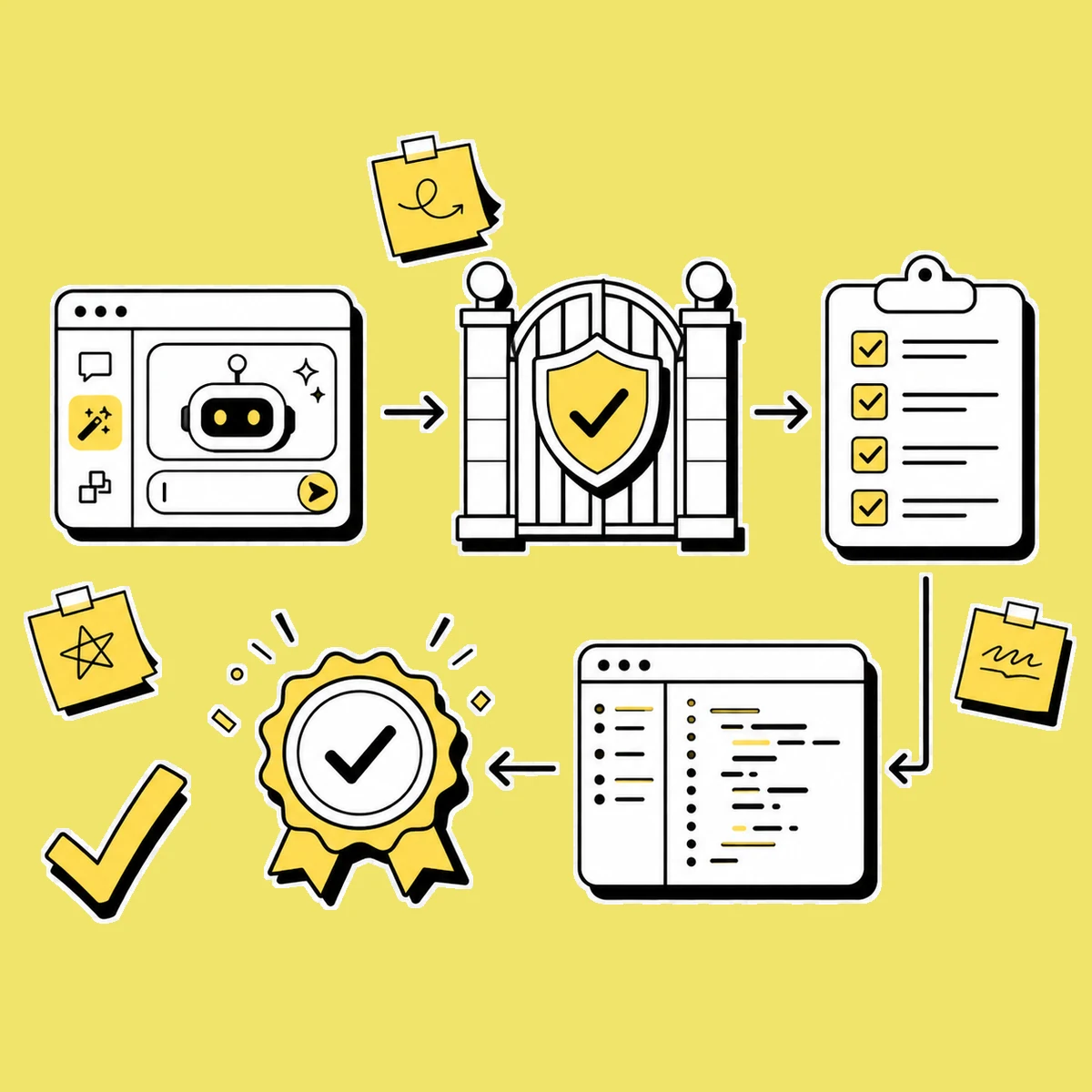
When we talk to engineering leaders about AI adoption, the same pattern shows up again and again: tool access arrives first, workflow approval arrives later, and by the time leadership asks for proof, nobody can explain what the operating model actually is.
That is what we built .consulting for.
The market has already moved past the question of whether engineers will use AI. Anthropic's Economic Index, published on February 10, 2025, showed AI usage concentrated in software development and technical writing tasks, and its April 28, 2025 software-development analysis was based on 500,000 coding-related interactions across Claude.ai and Claude Code. GitHub's August 2024 enterprise survey, which included respondents in Germany and was updated on April 15, 2025, showed that AI coding tools were already broadly used across enterprise software teams.
So the strategic question is no longer Should our engineers touch AI?
The real question is What exactly are we approving, for whom, under which review rules, and with what evidence that the model is holding?
Our practical definition of an approved workflow
An approved AI workflow is not a tool subscription.
It is a named engineering task pattern with a clear boundary, a preferred tool path, an explicit review rule, and a known owner.
If an engineering team says we use AI for implementation support, that is still too vague. If the same team says we allow AI-assisted draft generation for internal service code under repository-specific review rules, with manual validation before merge and a named engineering manager accountable for adoption, that is much closer to a real operating model.
We usually break it down like this:
| Layer | What must be decided | What fails if it stays vague |
|---|---|---|
| Workflow | Which task is actually in scope | Teams apply different interpretations |
| Tooling | Which tools are allowed for that workflow | Tool sprawl becomes policy drift |
| Review | What a reviewer must verify | Quality standards fragment by team |
| Ownership | Who decides, reinforces, and escalates | Rollout becomes nobody's job |
| Evidence | What counts as adoption or misuse | Leadership hears stories, not proof |
That table is simple on purpose. Most AI rollouts get weaker, not stronger, when they become more abstract.
Why most engineering AI rollouts stall
In mature organizations, AI adoption rarely stalls because developers are unwilling. It stalls because the organization tries to scale behavior before it has agreed on the operating rules.
Three failure modes show up most often.
1. Tool choice is treated like strategy
Teams spend weeks comparing model vendors and IDE integrations while staying vague about the workflow itself. That almost always reverses the decision order.
The workflow should lead.
If you cannot name the repeatable engineering task you want to improve, you are not really evaluating a tool. You are buying optionality and hoping the operating model will emerge later.
2. Human review becomes symbolic
Many teams will say of course a human still reviews the output, but that sentence hides the actual question: what exactly is the human expected to check?
If reviewers are not aligned on what good looks like, then human review becomes a comfort phrase rather than a control. One reviewer checks style, another checks architecture, another assumes the AI draft was already validated, and the team calls that governance.
It is not.
3. Adoption is confused with enthusiasm
A lot of leadership teams hear active usage and assume rollout is working. But active usage can still mean:
- different teams using different prompts for the same task
- no shared validation steps
- no agreement on when AI should not be used
- no manager reinforcement
- no evidence that the workflow is becoming repeatable
That is experimentation, not adoption.
The five decisions we want in place before wider rollout
If we were assessing a team tomorrow, we would ask for five decisions before recommending broader enablement.
Decision 1: the first workflow boundary
Pick one or two engineering workflows that are repeated often enough to justify formal rollout.
Good examples:
- internal implementation support
- test case drafting
- documentation and migration assistance
- pull request summarization for specific repositories
Weak examples:
AI for productivityAI for codingAI for whatever helps
The more generic the label, the weaker the approval logic becomes.
Decision 2: the preferred tool path
This does not mean every engineer loses all flexibility forever. It means the organization defines a default path it can support, evaluate, and review.
Without that, every incident becomes a fresh debate about whether the problem came from the workflow, the model, the IDE, the extension stack, or the developer's personal setup.
Decision 3: the review standard
The review standard should answer questions like:
- What must still be manually checked?
- Which classes of code or data require stricter handling?
- When should AI output be rejected even if it appears to work?
- Which repositories or systems are out of scope?
This is the moment where human-in-the-loop stops being a slogan and becomes a control.
Decision 4: the ownership map
We want at least four owners visible:
| Role | Ownership question |
|---|---|
| Executive sponsor | Why are we doing this now? |
| Engineering manager | Who reinforces it in daily work? |
| Technical reviewer | What counts as acceptable output? |
| Control function partner | Which policy boundary cannot be crossed? |
When nobody owns reinforcement, rollout always decays after the kickoff.
Decision 5: the first adoption checkpoint
Before wider rollout starts, the team should already know what evidence it will review later.
Not ROI theater. Not 10x developer mythology. Just a real checkpoint.
For example:
- Are the named teams using the approved workflow at all?
- Are they using the agreed tool path?
- Are reviewers applying the same validation rules?
- Have the known guardrails held under real use?
If the answer to those questions is we will figure it out later, then the organization is not really rolling out a workflow yet.
Our bias: start narrower than you want
One of the most common commercial mistakes in this market is forcing too much scope into the first promise.
We would rather see a company approve one real workflow with named ownership than announce a broad engineering AI program that dissolves into exceptions, local habits, and political tool debates.
The most dangerous rollout is not the slow one.
It is the one that looks fast because usage spreads before the operating model does.
A useful rule for leaders
If you want one simple test, use this:
If the review owner is not named, the workflow is not approved.
That rule is blunt, but it is effective. It forces a buyer to leave the language of inspiration and enter the language of operating responsibility.
Where we would start next
If your organization already has AI activity across multiple engineers or teams, we would not start with another generic training day.
We would start with:
- one workflow shortlist
- one preferred tool path per workflow
- one review standard per workflow
- one named manager owner
- one adoption checkpoint on the calendar
That is the minimum shape of a rollout that can survive contact with real engineering work.
A final note
We do not think engineering leaders need more AI excitement in 2026.
They need a way to make the rollout legible.
That means turning AI from a loose set of individual habits into a workflow system with boundaries, owners, and review logic that can hold up under pressure. Once that exists, enablement becomes useful. Before that, it mostly multiplies ambiguity.
Sources
- Anthropic,
The Anthropic Economic Index, February 10, 2025 - Anthropic,
Anthropic Economic Index: AI's impact on software development, April 28, 2025 - GitHub,
Survey: The AI wave continues to grow on software development teams, August 20, 2024, updated April 15, 2025